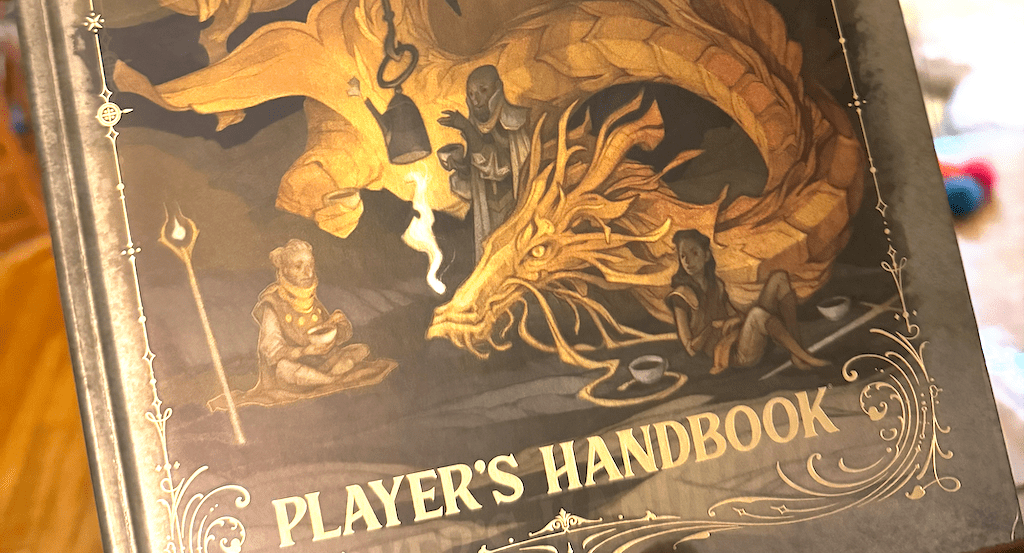
There’s no shortage of hot takes and reviews of the recently released 2024 Player’s Handbook for Dungeons & Dragons, but I figured I’d add to the pile with my own views. Caveat lector: I’ve only just started using these rules in my own games so these are just hot takes. We’ll see how it goes!
I think that the biggest improvement is the layout of the rules themselves; a lot of the technical details and random info you only sometimes need are sequestered away in the glossary, leaving most of the book for classes, species, backgrounds, and spells.
This works really well because, especially for a new player, all those extra paragraphs of text (what is exhaustion? How does breaking an object work?) make the game seem more complicated than it really is.
When I introduce players to the game, I can sum up most things in one sentence:
When asked, decide what you what your character to do, and if there’s a chance it will fail, you will be asked to roll a 20 sided die and add something to the result to find out what happens.
The 2014 Player’s Handbook was more friendly than previous editions for sure, but it didn’t convey this beautiful simplicity. I think that the 2024 edition finally does. It’s actually an accessible introduction to the game that makes it feel exciting.
So what’s new?
The classes themselves have had their abilities heavily rebalanced in the manner of a World of Warcraft patch, and there’s way more options than the 2014 edition (lots of subclasses! lots of feats!). However, to be honest there’s more that hasn’t changed than there is that differs.
I think this is a good thing. 5th Edition is overall a great ruleset and there’s not much need to throw it out.
That said, here’s some differences that I think do stand out.
Species no longer controls ability scores.
Species (previously Race) has been refactored to be much more of a roleplaying choice than a mechanical one, which is great and will generate a lot less min-maxing or house ruling for those who want to play characters of different species. Species now grants only size and speed, as well as some specific abilities. Ability score upgrades now comes with Background, and there’s a lot more choice in what abilities get that bonus.
Weapon Mastery makes weapons interesting again.
Some of the weapons in 3e had interesting properties that could make combat more interesting than just “hit and be hit”. You could, for example, make a trip attack with certain pole arms.
These abilities were stripped out to make the game less complex but the 2024 PHB has added them back and has done one better: every weapon now has a special ability, but these options only apply when a class grants Weapon Mastery.
Barbarians can extend their rage with a bonus action and it lasts 10 minutes.
This is great. Barbarian Rage is the core mechanic of the class and it’s always been useful outside of combat. You get advantage on Strength checks! These changes make it much more feasible to use it anytime you want.
Druids can all Wild Shape as a bonus action but keep their hit points.
Previously, only Circle of the Moon druids could use Wild Shape as a bonus action; everyone else had to use a full action, which (combined with being able to choose more useful shapes) made Circle of the Moon arguably much better than other Druid choices. In the new edition, this imbalance is gone.
However, note that Druids no longer replace their hit points with the beast’s hit points when they transform. Now they just get temporary hit points equal to their level. Circle of the Moon Druids still have the advantage there though: they get 3 times that.
Paladin divine smite is now a spell and it uses a bonus action (although you get one for free every Long Rest).
I like this but it’s is probably more divisive because it nerfs the core ability of the Paladin class. Previously you could use Divine Smite on any attack, so it could be dropped on multiple attacks per round or even opportunity attacks. Because of the bonus action requirement, it now will only operate on your turn and only once per round.
But this also goes toward fixing the biggest problem (in my opinion) with the 2014 Paladin: Smites are too good and it’s too easy to have them use up all your spell slots. Making them less frequent encourages doing other things (and increases the utility of multiclassing). Paladins now get spells at 1st level, a second Channel Divinity, and Weapon Mastery.
Monks can use some abilities for free and combo them.
The 2014 Monk class introduced three core abilities: Flurry of Blows, Patient Defense, and Step of the Wind. The most iconic, Flurry of Blows, hasn’t changed in 2024, but the others are much more interesting.
Previously, you had to spend a Ki point (now called Focus points) to activate each, and they allowed using the Dodge action or Disengage action as a Bonus action, respectively. Now they allow using Disengage or Dash as a Bonus action for free, respectively, but if you add a Focus point you can do even more. You have the option to take both Disengage and Dodge, or Disengage and Dash.
This change transforms the ability from a poor copy of the Rogue’s Cunning Action into a really unique feature.
Monks can also now deflect melee attacks and not just ranged attacks at level 3 with Deflect Attacks, and Stunning Strike slows its target even if they succeed on their saving throw.
Sleep is useful against higher level creatures.
The Sleep spell has been underwhelming my players since 5e came out. It uses a pool of dice to determine how many hit points of creatures it can knock unconscious, starting from the lowest HP. This all but means that the spell is only ever useful against low-level creatures.
In the 2024 edition, the spell now just triggers a saving throw to resist, making it scale with all other spells.
Daylight is now useful against vampires.
This one took me by surprise. As a DM I’ve frequently had players try to use a spell named “Daylight” to harm Vampires and other creatures sensitive to sunlight, only to discover that the spell creates “bright light”, but not “sunlight”.
In 2024, the Daylight spell now creates sunlight. For a low-level spell this is a significant bump in power.
Healing spells heal twice the hit points
This is a huge change and I’m curious to see how it functions. Cure wounds and Healing word used to heal 1d8 per level and 1d4 per level and now they heal 2d8 per level and 2d4 per level respectively.
Conjure spells no longer need stat blocks.
This is just nice. One less thing to look up. The 2014 PHB reads, “the DM has the creature’s statistics” for each of the “Conjure” spells (eg: Conjure Animals, Conjure Elemental, etc.), but now these spells create “intangible spirits” which operate more like spell effects. They can’t be attacked and operate more like Spiritual Weapon. But also…
Summon spells are back and their stat blocks are included.
In 3e D&D and earlier, the popular Summon Monster spells could create all sorts of monsters as a temporary ally. These were removed in 5e and replaced with the “Conjure” spells which were limited to animals, celestials, and elementals.
In the 2024 PHB, we get both. The main difference is that Conjure spells now create pseudo-creatures (see above) that are really just spell effects in disguise, where Summon spells actually bring in autonomous creatures. And there are a lot! You can summon Aberrations, Beasts, Celestials, Constructs, Dragons, Elementals, Fey, Fiends, or Undead. “The DM has the creature’s statistics” is gone though and replaced with a stat block right there with the spell. Beautiful.
Grappling has been made more streamlined.
Another rule that’s been tweaked and adjusted for years since 3e is Grappling. It’s an iconic part of many action scenes and the 3e version was notoriously hard to understand. 5e is much better, but they’ve streamlined it even more.
Grappling now uses Unarmed Strike as its trigger and requires a Dex or Str saving throw (DC of 8 + the attack bonus) instead of an opposed ability check. Less rolling and faster play.
Surprised creatures in combat now just have disadvantage on their initiative roll.
How to handle surprise in combat has been hotly debated for decades and each edition of D&D since 3e (and Pathfinder) has had its own interpretation. The real currency of combat is the “action economy”. Rules which give players or enemies more actions can be overwhelming. This change makes surprise much more balanced. 5e has always been about elegant simplification and I think this follows that strategy.
Perception and Investigation are more clearly explained.
The “Study” and “Search” actions make it much more clear when to use Perception (“…discern something that isn’t obvious”) vs. Investigation (“…study your memory, a book, a clue, or another source of knowledge… [about] traps, ciphers, riddles, and gadgetry”). I just like that this distinction has been made more obvious.
Exhaustion is much simpler.
Arguably the 2014 version of Exhaustion was not complicated: each level had a row on a table and told you what bad things happened. But now there’s no table needed: it just reduces all d20 rolls by 2 x your Exhaustion level and reduces your speed by 5 x your Exhaustion level. One less thing to look up.
Stealth checks made for the Hide action are simpler.
You now just have to beat a DC 15, assuming you can leave your enemy’s line of sight, rather than the opposed roll needed by the 2014 edition. As a DM I appreciate anything that makes the game faster and this will do that by reducing die rolls (and of course it’s possible to change the DC or even do an opposed roll if that feels better for the circumstances).
Using a healing potion is a bonus action.
This has been a house rule in my home games for years. I’m glad to see it enshrined as an official thing. Healing shouldn’t take up a whole turn.
You can craft all kinds of things.
Immediately cool is the clearly written ability to craft Healing Potions for 25 gp, an Herbalism Kit and 8 hours, but there are also a full two pages devoted to other tools and what you can craft with them. In addition, each set of tools has a “Utilize” action that you can use to do something interesting, like “Detect poison drink” for Brewer’s Supplies or “Discern what a ceramic object held” for Potter’s Tools.
This elegantly allows moving the frequently confusing “Pick locks” and “Disarm traps” actions (which used to be unlisted skill checks) into the “Utilize” section of Thieves’ Tools.
Counterspell uses a saving throw.
Previously, Counterspell automatically cancelled a spell of the same level or lower and required a spellcasting ability check of DC 10 + spell level for higher level spells. Now, the spell is cancelled if the original spell’s caster fails a Constitution saving throw regardless of its level.
Aside from getting rid of the free counter, this changes the spell from the counterspell caster’s roll to the defender’s roll. More powerful enemies are therefore more likely to avoid losing their spells, but more powerful spells are no longer any harder to counter. It’s a double-edged sword, and there’s one more very important twist: if a spell is countered, its slot is not used. That’s a good thing because it’s much easier to counter those precious high-level spell slots and now the only thing the caster loses is their action. This will benefit the players more than enemies who tend to have a hand-wavey number of spell slots anyway.
On the other hand, you do miss out on the excitement of the player rolling to counter a powerful spell. I’m torn here.
Overall impression.
Although there are some things that are probably going to take some getting used to, I love two main things about the 2024 Player’s Handbook: that it’s changed a ton of things to make them easier to use, and that very little has been changed at all. I think it really showcases the community-based process that they used to make this new ruleset, and I can’t wait to play with these new toys in my own games.
 Payton.Codes
Leave a reply to D&D 5e Rules – Overview and Table of Contents | Blog of Heroes Cancel reply